Nepal signed off their ICC Men's T20 World Cup 2026 campaign with a win that felt bigger than two points. After a 12-year wait, the Rhinos finally tasted their third T20 World Cup victory, outclassing Scotland by seven wickets in front of a roaring Nepali crowd in Mumbai.
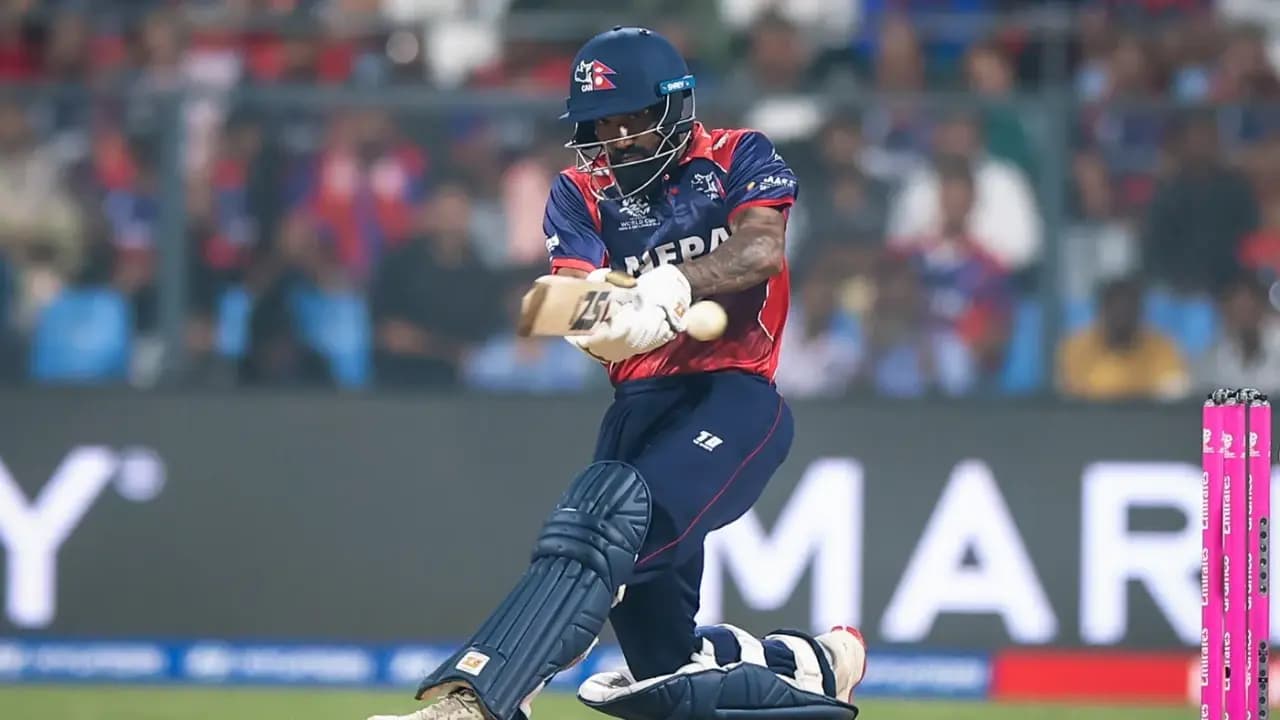
The chase had its twists, the kind Nepal have made a habit of delivering, but Dipendra Singh Airee made sure there was no heartbreak in the end. Airee blasted an unbeaten 50 off 23 balls, striking four fours and three sixes, and here's the crazy part, he played only two dot balls in the entire innings. Pure intent, no pause.
It was also a landmark knock. Airee registered his second successive T20 World Cup fifty, becoming the first Nepali batter to score two half-centuries in a T20 World Cup.
Scotland fly early, Kami flips the script
Scotland came hard in the powerplay, racing to 52/0 in 6 overs, with Michael Jones setting the pace. They brought up 50 in just 5.2 overs, and Jones’ fifty came off 31 balls (6 fours, 2 sixes). At one point, Scotland looked set for something massive, reaching 150 in 17.2 overs.
But Nepal’s comeback began with Sompal Kami, the senior pro who still knows exactly how to tilt games. Scotland’s smooth cruise turned into a wobble, then a collapse, as Nepal hit back hard late. Scotland eventually finished 170/7, losing momentum just when they needed a final surge.
Nepal boss the powerplay, then wobble badly
Nepal’s reply started even stronger. The openers smashed 56/0 in the powerplay, matching Scotland’s tempo shot for shot. Nepal reached 50 in 5.1 overs, and the chase looked under control.
Then came the swing. Scotland’s Michael Leask flipped the match with a brutal spell, triggering a slide from 74/0 to 98/3. The crowd went quiet, Nepal looked shaky, and the equation started to bite.
At the end of that phase, Nepal needed a big finish, and that’s when Airee walked in and did what Airee does.
Airee time: two dot balls, maximum damage
Nepal were still deep in the contest when the required rate climbed. Airee didn’t negotiate. He attacked.
He found boundaries, turned ones into twos, and kept Scotland’s bowlers under constant pressure. The partnership with Gulshan Jha became the match-defining moment, a 50-run stand in just 27 balls for the fourth wicket. Nepal surged to 150 in 17.5 overs, and Scotland's fight finally broke.
Airee raised his fifty in 23 balls, and Nepal crossed the line at 171/3, sealing the chase with composure and noise all around.