

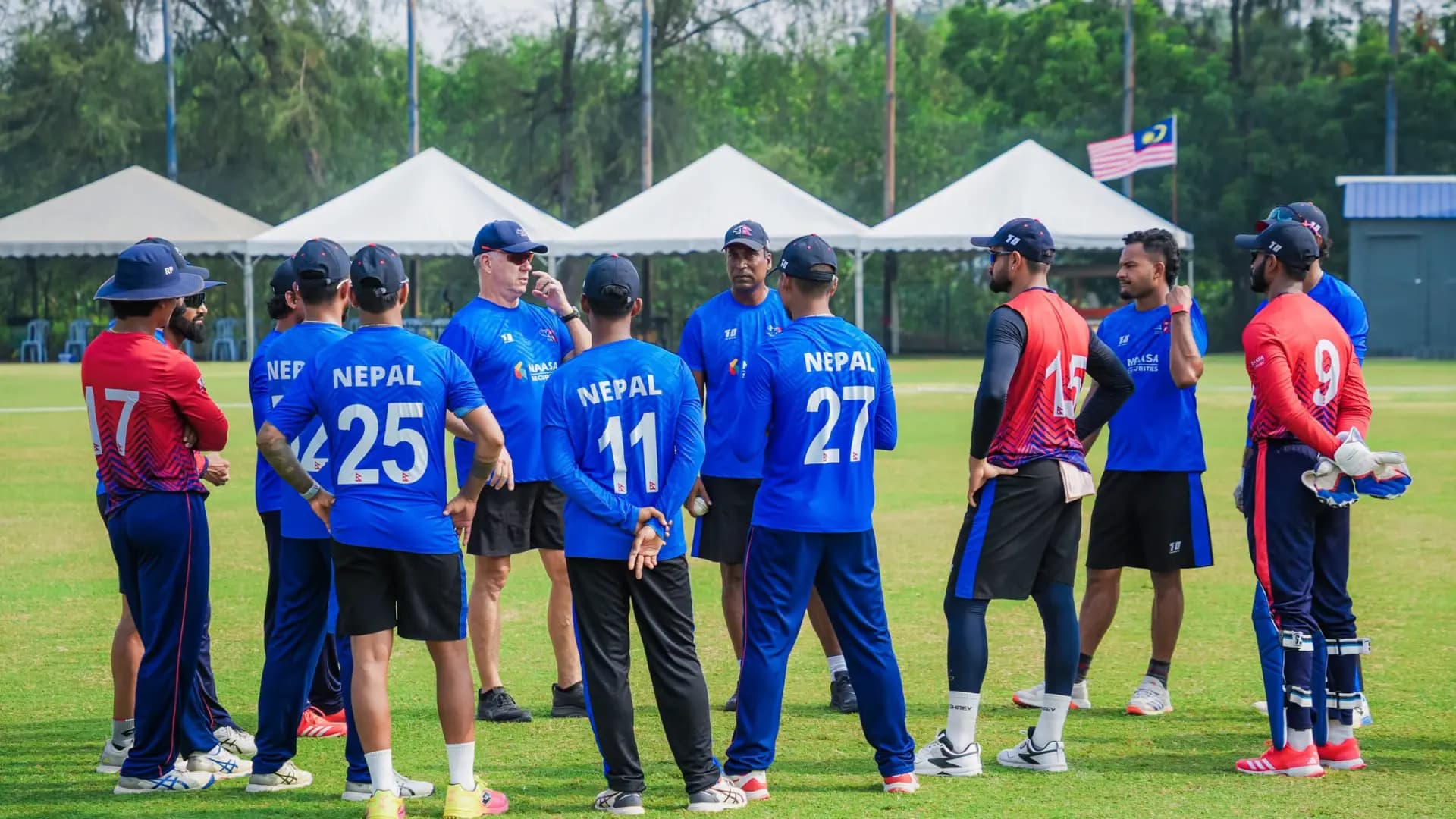
Nepal enter the 2026 ACC Men's Premier Cup in Malaysia with two immediate objectives: win their way back to the Asia Cup and restore confidence in a one-day side shaken by a difficult run in ICC Cricket World Cup League 2.
The ten-team tournament began on August 30 and concludes on September 12. Nepal will open their Group A campaign against Bahrain at the YSD-UKM Cricket Oval in Bangi on Monday.
Malaysia, Hong Kong and Saudi Arabia complete Nepal's group. Group B consists of the United Arab Emirates, Oman, Kuwait, Qatar and Singapore.
Each team plays four group matches, with the top two sides from each group advancing to the semi-finals. The tournament winner will qualify for the 2027 Men’s Asia Cup in Bangladesh.
For Nepal, that leaves little room for an off day. Their group appears manageable on paper, but reaching the semi-finals is only the first requirement. UAE and Oman are the leading contenders in Group B and could stand between Nepal and the title during the knockout stage.
Lamichhane takes charge of reshaped side
The competition begins a new phase for Nepal's ODI team, with Sandeep Lamichhane returning as captain in place of Rohit Paudel.
Lamichhane previously captained Nepal in 14 ODIs before Paudel took over in 2022. The leg-spinner returned to the role following Nepal's winless League 2 tour of the Netherlands, where they lost twice each to the hosts and Namibia.
The captaincy change has been accompanied by a substantial reshaping of the squad. Kushal Bhurtel, Bhim Sharki, Aarif Sheikh, Binod Bhandari, Sompal Kami and Nandan Yadav have not been retained from the 16-member group that toured the Netherlands.
Dev Khanal, Basir Ahamad, Sher Malla and Sundeep Jora have returned, while Arjun Kumal is in contention to open alongside Aasif Sheikh. Hemant Dhami provides another pace-bowling option following the omissions of Sompal and Nandan.
The changes place greater responsibility on both the returning players and those seeking to establish themselves in Nepal’s ODI plans. Kumal’s possible promotion is particularly significant after he did not feature during the Netherlands tri-series despite Nepal’s repeated batting failures.
Lamichhane will also remain central to Nepal's plans with the ball. The 26-year-old entered his new captaincy spell with 154 wickets from 77 ODIs, making his wicket-taking threat through the middle overs one of Nepal’s most important assets.
Batting remains the central concern
Nepal spent two weeks training in India before travelling to Malaysia, where they played two practice matches against the Karnataka.
The results were encouraging, but the contrasting batting performances underlined the inconsistency that has followed the team.
Nepal chased 228 in only 28 overs for the loss of one wicket in the first practice match. In the second, however, they were dismissed for 170 inside 42 overs before recovering with the ball to complete a 27-run victory.
That difference captures Nepal’s biggest challenge. Their bowling attack can keep them competitive, but qualification may depend on whether the batting unit can deliver consistently across four group matches and two possible knockout games.
Aasif Sheikh's role at the top, Rohit Paudel's ability to anchor the middle order and the contributions of all-rounders Dipendra Singh Airee and Gulshan Jha will be crucial. Nepal must also decide how much opportunity to give returning and emerging batters before the knockout stage.
The lower-profile group opponents should not encourage experimentation at the expense of results. Hosts Malaysia know the conditions, Hong Kong have a history of challenging Nepal in associate competition, and Bahrain and Saudi Arabia have an opportunity to play without the same weight of expectation.
A route back to the Asia Cup
Nepal won the inaugural ACC Men's Premier Cup at home in 2023, defeating UAE by seven wickets in the final at the TU Cricket Ground. That triumph secured their first Asia Cup appearance, where they faced Pakistan and India.
The 2024 Premier Cup was played in the T20 format and won by UAE. The competition has returned to 50-over cricket for 2026, making Nepal the most recent champion from its one-day edition.

Success in Malaysia would therefore bring Nepal back to the continental stage while providing an important lift ahead of their remaining League 2 commitments.
The Premier Cup does not directly determine Nepal's ODI status, but its timing makes the tournament an important part of their attempt to reverse a worrying decline. Nepal entered the competition seventh in the eight-team League 2 standings, with 11 wins and 19 defeats from 32 matches.
Their final League 2 tri-series against Oman and Canada is scheduled to begin three weeks after the Premier Cup. A strong run in Malaysia could restore confidence before that assignment; another inconsistent campaign would deepen the questions surrounding Nepal’s 50-over cricket.
Nepal's group-stage fixtures
August 31: Bahrain vs Nepal, YSD-UKM Cricket Oval, Bangi — 7:15am Nepal time
September 3: Malaysia vs Nepal, YSD-UKM Cricket Oval, Bangi — 7:15am Nepal time
September 6: Nepal vs Saudi Arabia, Bayuemas Oval, Kuala Lumpur — 7:15am Nepal time
September 8: Hong Kong vs Nepal, Bayuemas Oval, Kuala Lumpur — 7:15am Nepal time
Semi-finals will be played on September 10, followed by the final and third-place playoff on September 12.
What Nepal must get right
Nepal's spin attack should remain one of their strengths, particularly if Lamichhane, Lalit Rajbanshi and the other slow-bowling options can control the middle overs. Their larger concern is building competitive totals without leaving too much work for the bowlers.
The opening combination must provide stability, the middle order must convert starts and the emerging players need enough opportunity to justify their recalls. Lamichhane, meanwhile, faces the additional test of balancing his role as Nepal’s leading wicket-taking threat with the tactical demands of captaincy.
Nepal begin among the leading title contenders, but reputation alone will not take them back to the Asia Cup. Six disciplined performances could do so.
Follow this story
More from ACC Premier Cup
Rohit Paudel fined after heated exchange in Premier Cup final
Aasif Sheikh credits teammates after title-winning century
Sandeep Lamichhane dedicates Premier Cup triumph to Nepal flood victims